More People Are Using AI. Fewer of Them Trust It.
AI usage among small business employees is up sharply this year. Confidence in using it fell just as fast. Here's what that gap actually tells you.
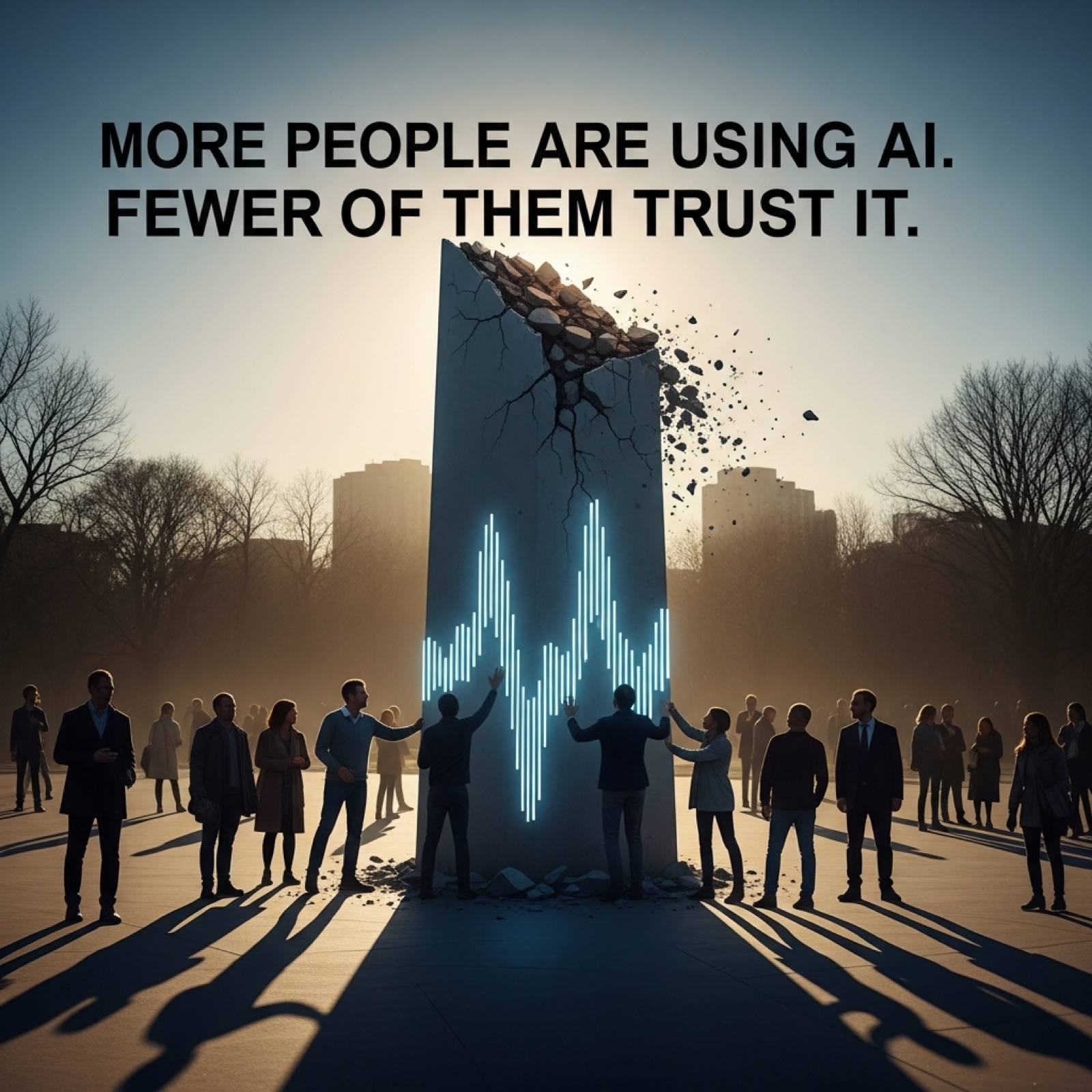
AI usage among small business employees jumped 13 percent this year. Confidence in using it fell 18 percent in the same period.
That data is from Business.com's 2026 Small Business AI Outlook, and it's one of the more honest numbers I've seen in a while. Not because it's surprising, but because it names something most AI adoption conversations work hard to avoid.
More use. Less certainty. Both moving at the same time, in opposite directions.
When a technology spreads faster than people's ability to evaluate it, you get a specific kind of discomfort. It's not fear that the tools don't work. It's the uncertainty of not knowing when you're using them well. You get an output. You can't always tell if it's good. You use it anyway, or you don't, and there's a background hum of unresolved doubt either way.
This is a different problem than the one most businesses were solving two years ago, when the question was whether AI tools were reliable enough to use at all. That question is mostly settled. The current one is harder: how do you build actual judgment about a tool that gives you plausible-sounding answers in domains where you might not already know what good looks like?
What confidence in a skill actually requires
Think about how people develop confidence in anything. You try it. You see the result. You adjust. Over enough repetitions with clear feedback, you build an internal model of what good looks like. That loop is slower with AI tools because the feedback is often ambiguous. You get something that looks reasonable. It might be exactly right. It might have drifted in ways you won't notice until someone else does.
The same report found that managers save more than twice as much time from AI as individual contributors do: 7.2 hours versus 3.4 hours per week. That gap probably tells us something important. Managers tend to apply AI to tasks where they already have strong judgment. Drafting communications. Synthesizing information from multiple sources. Reviewing work they could evaluate anyway. They can tell quickly whether the output is useful because they know the domain.
Individual contributors using AI on tasks they're still developing expertise in face a harder problem. They can't always tell whether the output is helping them or subtly misleading them, and it's difficult to calibrate on work you delegated before you could evaluate it yourself.
Confidence isn't comfort with technology. It's having enough repetitions with clear outcomes to know what to trust and what to check.
The practical implication
The businesses that will close this confidence gap fastest are not the ones using the most AI tools. They're the ones using fewer tools on tasks where the output is easy to evaluate.
Pick one workflow. Something with a clear right answer, or at least an obvious wrong signal. First drafts of job postings. Meeting note summaries. Standard client follow-up emails. Use AI for that one task consistently, until you have an honest read on where it helps and where it needs your judgment. The confidence you're building is not in AI as a category. It's in AI for that specific thing, in your specific context. That's the only kind that actually transfers into better decisions over time.
If your team is using AI regularly but the confidence isn't following, the instinct is usually to add training or switch tools. Neither typically works on its own. What usually works is narrowing scope: fewer tasks, faster feedback loops, enough repetitions to build a real model of what good looks like in that situation.
Forty-five percent of small business workers now use AI regularly. That's a lot of people accumulating hours.
The question worth asking is whether those hours are producing insight about when to rely on the tool and when to step in, or whether they're just hours. After a few years of AI everywhere, the gap between those two things is starting to matter.
Free: AI Readiness Checklist
Find out if your business is ready for AI automation. 10 questions, 2 minutes.