The Real Reason AI Isn't Paying Off for Most Businesses
PwC surveyed 1,200 executives and found 74% of AI's economic gains go to just 20% of companies. The gap is real, and the reason isn't the tools.
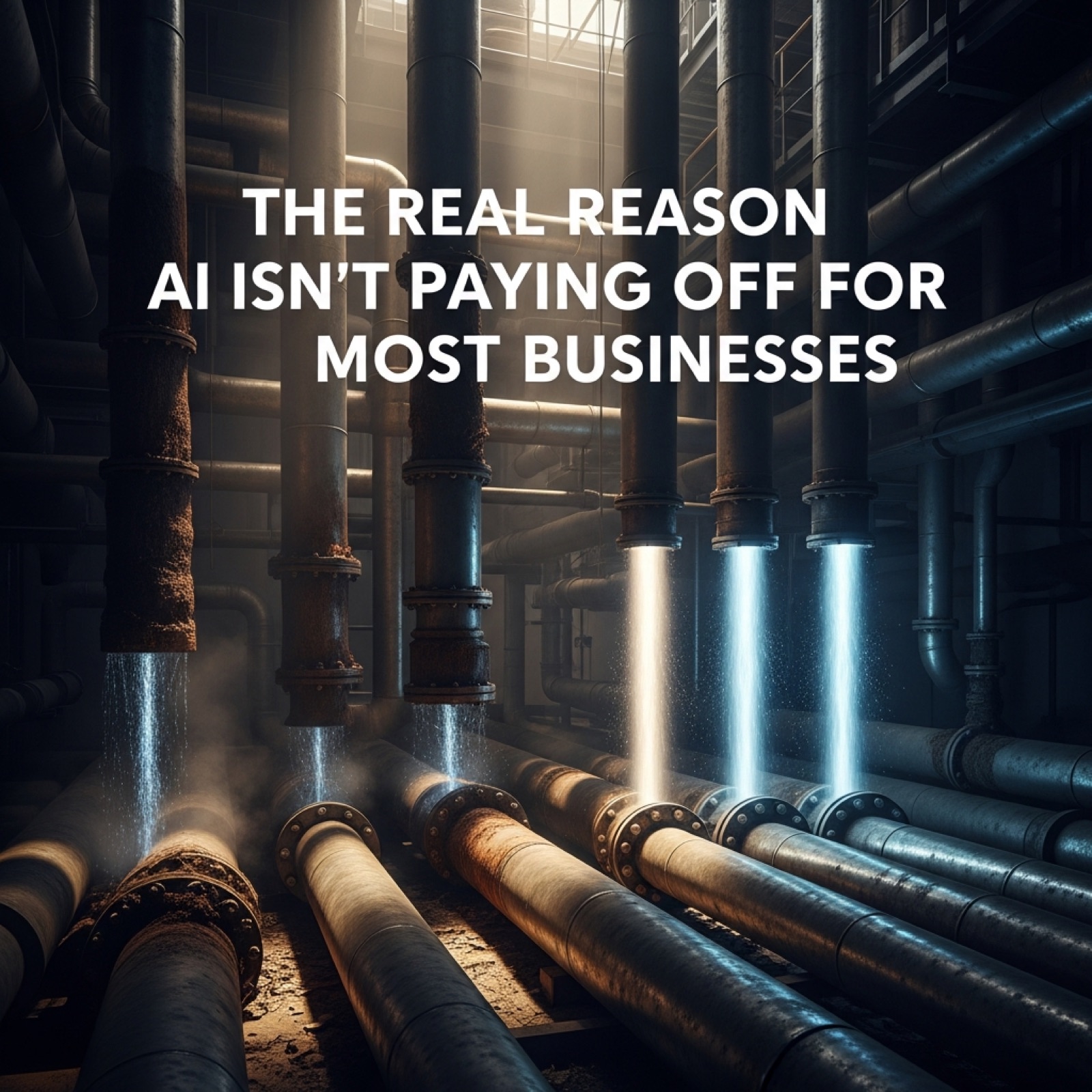
PwC released its 2026 AI Performance Study last week. They surveyed 1,217 senior executives across 25 industries and found that 74% of AI's economic value is flowing to just 20% of organizations. The top performers are generating 7.2 times more AI-driven revenue and efficiency gains than the average competitor.
The natural reaction to a stat like that is to wonder which tools the top 20% are using. That's the wrong question.
PwC found that the leading companies are not just better at picking software. They're doing something structurally different. Companies in the top tier are twice as likely to redesign their workflows around AI rather than layer AI onto the workflows they already have.
That's the actual insight. Not which model they're using. Not which vendor they chose. The question is whether they built the workflow for humans and then handed AI a role inside it, or whether they started by asking what the workflow would look like if AI were doing the work from the beginning.
Most businesses are doing the first thing. It's the more intuitive starting point. You have a process that works, you find a place where AI can speed it up or reduce the manual effort, and you drop it in. A ChatGPT window for drafting emails. An AI note-taker on Zoom calls. A tool that summarizes long documents before you read them.
These are real improvements. They're not nothing. But they're also not what creates a 7.2x gap.
Here's where I want to slow down a bit. Think about the last time your team got a productivity tool and genuinely changed how work got done, versus the last time you got a tool that just made the existing motion slightly faster. Faster motion is easier to measure and easier to justify in a budget conversation. Redesigning the motion is slower to start and harder to argue for. So most organizations never do it.
The PwC study found that the same top-performing group is also using AI to pursue growth and new revenue, not just to cut costs. That's the other meaningful difference. If your AI question is "how do we do this cheaper," you'll optimize your current model. If your question is "what can we now do that we couldn't do before," you end up somewhere different.
A concrete way to test which camp you're in: take one core part of your operation and ask what it would look like if you were building it from scratch today. Not "where can we plug in AI," but "if I had to run this with a three-person team instead of ten, what would each step actually be?" That question tends to surface the steps that exist only because humans needed handoffs, or because someone had to enter something into a spreadsheet before anyone else could move forward. Those steps are candidates for elimination, not automation.
The difference matters because automating a broken workflow just makes the broken workflow faster. Redesigning it around what AI can actually do is a different project entirely.
None of this requires a large IT budget or a dedicated AI team. The smaller organizations in the PwC study that were outperforming weren't doing it with enterprise tools. They were doing it with better questions about how work gets done. The tool is almost always available. The rethink is the scarce part.
The 74/20 split isn't going to close soon. If anything, it will widen as top performers compound their advantage. But it's also not locked in. Most organizations are still early enough in their AI adoption that the choices they're making right now will determine which side of that line they end up on.
The interesting part of the PwC findings is that being in the top 20% doesn't require being in a specific industry, having a specific size, or having started early. The distinguishing factor was strategic, not technical. That's a more open door than it might seem.
Free: AI Readiness Checklist
Find out if your business is ready for AI automation. 10 questions, 2 minutes.