What the SaaSpocalypse Actually Means for Your Business
Klarna dropped Salesforce and saved $2M. Then its CEO walked the story back. What actually happened tells you more about AI disruption than the headline did.
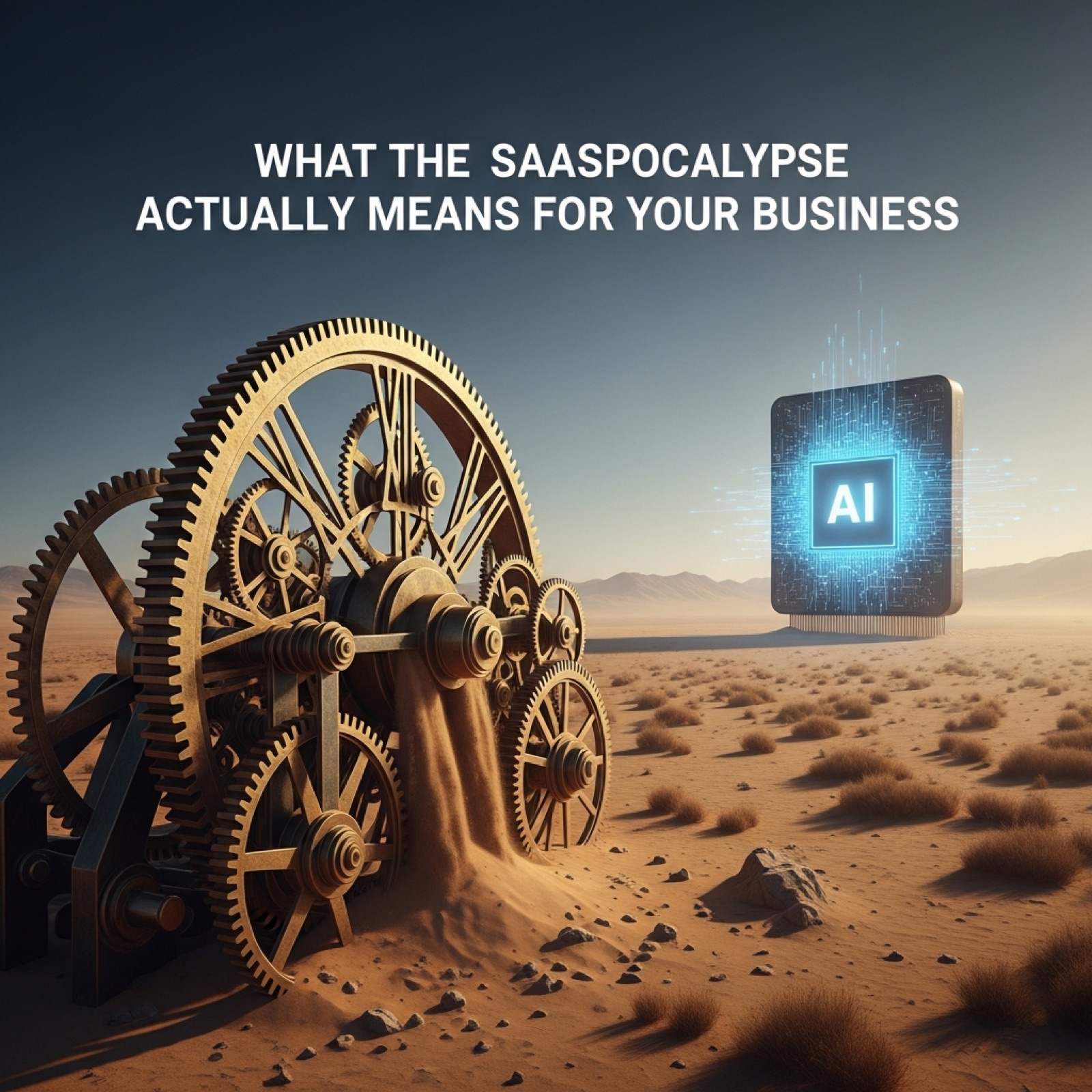
Klarna dropped Salesforce last year, replaced it with internally built AI tools, and saved about $2 million in the process. Tech publications ran with it. The S&P software index fell 20% in February. Wall Street coined a word: the SaaSpocalypse. The thesis was clean and viral: AI is going to eat enterprise software from the inside out.
Then Klarna's CEO walked it back.
Sebastian Siemiatkowski admitted publicly that he doesn't think other companies should follow his lead. He said he doesn't think it's the end of Salesforce. One analysis found that Klarna hadn't actually replaced SaaS with AI at all. They'd consolidated onto different SaaS tools and layered AI on top. What got reported as "AI kills the CRM" was really "company rationalized its software spend and used AI to fill the gaps."
That's a much less dramatic story. It's also a more useful one.
The market reaction was real, even if the narrative was sloppy. Atlassian fell 35%. Salesforce dropped 28%. About $2 trillion evaporated from the software sector in a month. That kind of move doesn't happen because of one company's procurement decision. It happens because investors looked at what AI agents can now do and started asking which software categories were most exposed.
The honest answer is: the ones that do one thing.
Think about the tools in your stack that exist primarily to solve a single workflow step. The scheduling tool that sends calendar links. The e-signature platform you use a handful of times a month. The template-based report generator. The standalone ticketing system. Each of these was a reasonable purchase because the alternative was doing it manually or building something from scratch. That trade-off still made sense when "from scratch" meant hiring a developer and waiting six months.
It makes less sense when an AI agent can handle the scheduling logic, the document flow, and the follow-up routing for less than the cost of a single subscription.
Gartner estimates 35% of point-product SaaS tools will be replaced by AI agents by 2030. That's the category to watch: point-products. Tools with a single function and no deep data moat.
The tools that are harder to rationalize away are the ones where the data is the value. A CRM you've actually built out over several years, with contact history, deal stages, and everything your team uses as a source of truth, is not easy to replace regardless of what an AI agent can do. The switching cost isn't the software. It's the years of structured information that lives inside it. Same logic applies to your accounting platform, your project history, anything where the value accumulates over time.
So the practical question is worth asking honestly: for each tool you renew, is the value in the software itself or in the data it holds?
If it's the software, it's worth flagging for review. Not immediately, and not in a panic. But the next time that renewal comes up, spend twenty minutes asking whether an AI workflow could do the same job. For scheduling tools and basic document automation, the answer is probably yes, and has been for a few months.
If it's the data, you're in a different position. You're not replacing the tool, you're managing a platform. The question there is whether the vendor is investing in AI capabilities fast enough to stay useful, which is a different calculation.
The SaaSpocalypse headline got ahead of the reality. Klarna's CEO had to clarify what actually happened. But the underlying signal, that AI is changing which software categories are defensible, is real. It just plays out category by category, renewal by renewal, rather than all at once.
Your stack probably has both kinds of tools in it. The ones worth protecting are the ones that know more about your business than you could easily rebuild elsewhere.
Free: AI Readiness Checklist
Find out if your business is ready for AI automation. 10 questions, 2 minutes.