Your Next Customer Might Be an AI Agent
Visa opened its payment network to AI agents that can complete purchases without human approval. Here is what that means for how you sell and how you spend.
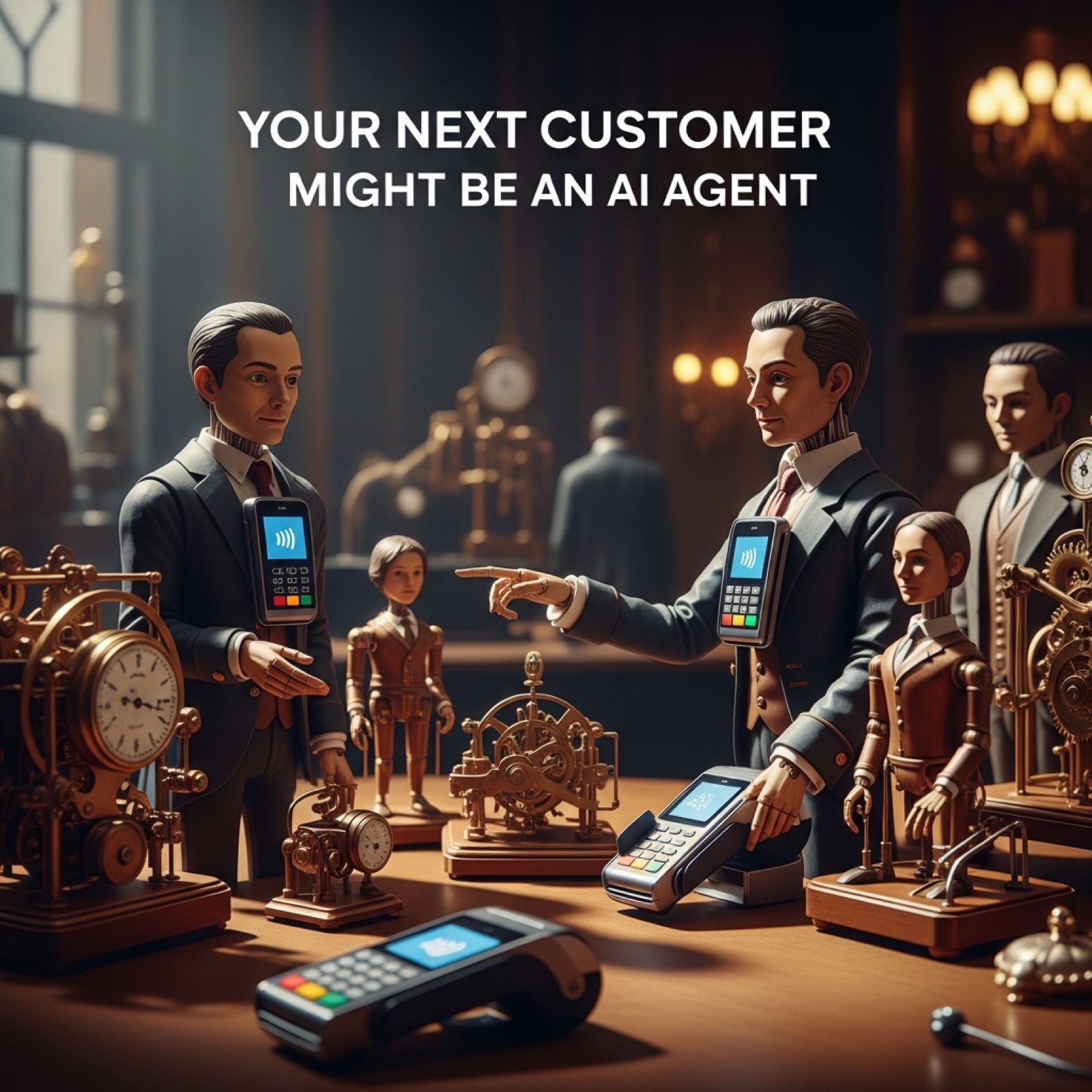
On April 8th, Visa opened its payment network to AI agents.
Intelligent Commerce Connect is Visa's new platform that lets AI agents initiate purchases, handle authentication, and complete transactions on behalf of users, without handing control back to a human at checkout. The full loop, closed by software.
Most of the coverage has focused on what this means for consumers — how AI assistants might someday handle grocery orders or book travel. That's the wrong frame if you run a business.
Here's what actually changes: if AI agents can buy, your products and services have to be discoverable to them.
Think about what that requires. A human browsing your website reads between the lines. They notice tone, trust a photo, make judgment calls about whether your offer fits their situation. An AI agent doing purchasing research works differently. It parses structured data. It looks for clear descriptions, defined deliverables, unambiguous pricing. It doesn't respond to vibes.
If your offer is buried in vague language, it may simply not surface.
This isn't an argument to strip the humanity out of your marketing. Most of your customers are still human, and most of them are still making decisions the way humans always have. But the businesses that benefit most from agentic commerce will be the ones that have thought clearly enough about what they offer that they can describe it precisely. That clarity helps human buyers too.
Here's a test worth running this week. Take your main service or product page and paste it into any AI assistant. Ask it: "Based on this page, what does this business offer, who is it for, and what would someone pay?" If the answer is fuzzy or incomplete, that's a signal worth taking seriously, not just for AI discoverability, but for how any buyer reads you.
There's a second implication that's easier to miss.
If AI agents can now purchase on behalf of users, they can also purchase on behalf of businesses. That means at some point, an AI agent you configure could handle recurring vendor payments, software subscriptions, supply orders, operating within spend limits you define. Visa's platform includes those controls. The infrastructure is there, not as a prototype but as production payment rails.
The pilot partners on Intelligent Commerce Connect include AWS, Mesh, and Payabli. This is payment infrastructure, not a consumer app in beta.
Stanford's 2026 AI Index found that AI agent deployment is still in the single digits across nearly all business functions. Most businesses aren't doing this yet. But the pattern with AI over the last three years has been consistent: the infrastructure arrives, then the use cases become obvious in retrospect, then everyone wonders why they waited.
The gap between "the infrastructure exists" and "my business uses it" is where the advantage lives right now.
Visa building this doesn't mean you need to change anything this week. But it does mean the window for thinking of AI as purely a writing or summarization tool is closing. The next layer of adoption isn't about content. It's about action.
If you want to get ahead of this, watch how your own purchasing behavior shifts over the next 12 months. Which vendors do you find more easily because an AI surfaced them? Which subscriptions start getting handled by an agent instead of a calendar reminder? That firsthand experience is your best preview of what your customers will eventually expect.
And when that shift happens, the businesses with the clearest descriptions of what they do will be the first ones the agents find.
Free: AI Readiness Checklist
Find out if your business is ready for AI automation. 10 questions, 2 minutes.